
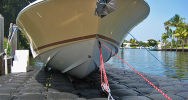
 Boat Docks
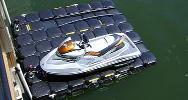 PWC Docks
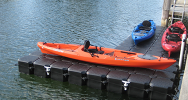 Kayak Docks
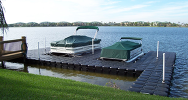 Floating Walkways
 Seaplane Docks
 Residential Docks
 Commercial Docks
 Saltwater Docks
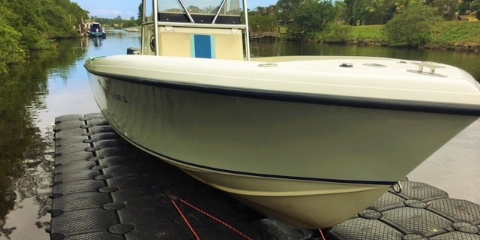 Lake & River Docks
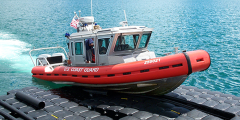 Government Docks
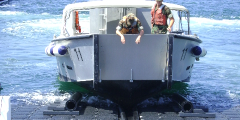 Military Docks
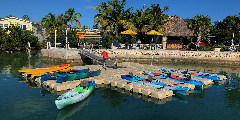 Parks & Recreation Boat Docks
 GSA Information
 Dealer Application
 Dealer List
 Jet Dock Advantages
 Boat Lift Photos
 Boat Lift Videos
 Knowledge Center
 Marine Forecasts
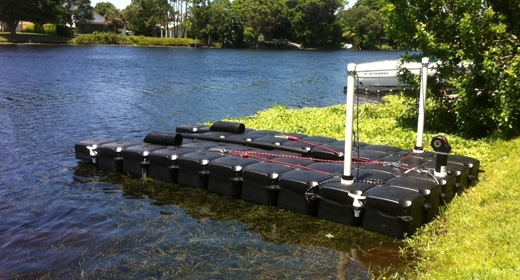
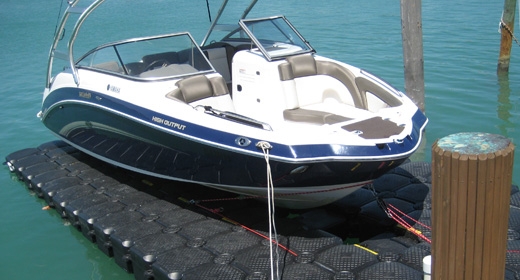
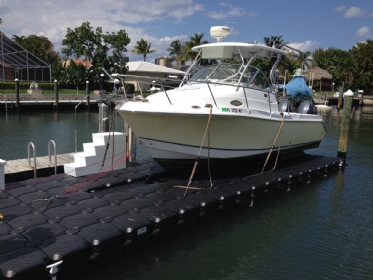
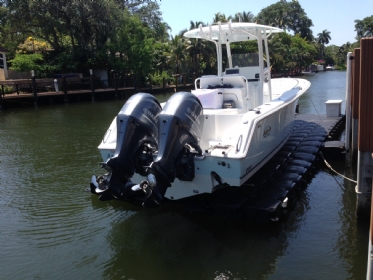
Our Frequently Asked Questions page will help you discover more information about our Jet Dock modular boat lift. Find answers to all of our most common questions on everything from boat lift installation to river dock storage. If you are interested in a custom quote or can't find the answer you are looking for, click below. Our customer team is happy to assist you with any additional questions you have.
Get a Custom Quote ▶Jet Dock Floating Boat Lift Frequently Asked Questions (FAQs)
The Jet Dock is a safe, convenient drive-on docking system. Composed of interlocking floating cubes, it is intended for quick and easy launching or mooring of your personal watercraft or boat. After you have completed the installation of your floating docks, the process is similar to driving onto your boat trailer.
To get your boat or personal watercraft on top of your floating dock:
- Approach the boat dock at idle speed and allow your momentum to slowly begin the drive-on process. As you do so, the leading edge of the floating dock will cradle your vessel.
- From here, gently apply the throttle to hold your boat in the "safety pause" position, about 1/3rd of the way onto the floating dock.
- When ready, firmly throttle on the rest of the way. After a few tries, you will know exactly how much thrust you need to get your boat on top of the river dock.
- Jet intake boats, like personal watercraft, require nearly a similar approach to a floating dock as outboard engine boats. The only difference with your personal watercraft is that you MAY have to winch the craft forward for less than two feet after the drive-on to clear the water and secure your vessel on your dry dock.
- Take your time when driving on the floating boat dock. Its tracking system will help control your boat regardless of wind, wake, or water currents.
- The winch systems installed with our floating docks can assist at any point during the docking process.
Remember that practice makes perfect. After successfully "parking" your vessel on your very own floating dock, doing so in the future will be as easy as parking your car in the garage.
To get the craft off the floating dock:
For personal watercraft (PWC)
- Simply stand in the stern (backside) of the wave runner dock and lightly tug at the craft, lifting up as you are pulling back at the same time. As you are doing this, your body weight will cause the dock to begin flexing down in the stern. It will take a reasonable amount of pressure when you start to lift the PWC and pull it back for it to begin sliding off the floating dock.
- After it begins moving, step on at any time as the PWC should now launch in a slow, controlled manner.
For boats (outboard, sterndrive-I/O, inboard) 12 - 30 feet in length:
- Lower your drive unit, shift into reverse, and drive off the boat dock.
- For vessels that are too far on the floating dock to drive off (and for inboard ski boats), a convenient winch-assisted launch system located at the front of the boat dock allows you to move the craft. The Z-pulley design on the winch system works in reverse and puts pressure on the bow eye of your vessel to bring it back to a teetering point, at which time you can hand launch your craft or start your engine, shift into reverse and drive off the floating dock.
- For craft between about 23’ and 55’, an “air-assisted” auto launching system is recommended which will prepare the craft to drive-off without the need for the Z-pulley launching process.
Black is the recommended color that our floating docks come in, at least for most drive-on applications. We have chosen to keep the cube its black color as other colors have historically exhibited less outdoor durability. Technically speaking, the carbon pigment in the polymer yields a black color. It provides the highest level of durability, strength, and flexibility. It is UV stable and requires no "additives" or inhibitors. Keeping with black high-density polyethylene (HDPE) allows us to maintain our Jet Dock lifetime warranty program, something not found on other boat lift installations. Consider these advantages:
- Our black cube makes the stains from dirt, grime, and marine growth less conspicuous than on white or light-colored floating docks
- The low-angle reflection of water is naturally dark, making the Jet Dock blend into the seascape
- The black color of the cube will not clash with your boat or surroundings
- Old modules in your Sea-Doo dock will not appear faded next to new modules
- Temperature of your PWC lift is partially regulated by the surrounding water
- Other docks, such as aluminum and wood, can have higher surface temperatures while introducing other hazards, such as splintering and rotting
- Lighter colored beige modules are also available upon request, especially for “barefoot” applications like swim platforms, paddleboards, etc. However the longevity may not be as extensive as the black modules.
Our floating dock can be left in all year (yes, even in saltwater; we have systems that have been in place for nearly ten years and have never been put on land for dry storage).
In some warmer weather sites where the water is completely drained (typically inland lakes or reservoirs at the end of the boating season), you may need to contact a Jet Dock customer support representative for seasonal boat lift installation and dock storage.
In cold weather sites (where the water freezes regularly during winter), your floating dock can be left in all year. When the water freezes, the boat dock rises up above the ice and rests on top.
Protocol for winterizing the Jet Dock is simple:
- Move the craft to its dry storage location during the off-season.
- Remove the mooring poles, or at the very least, untie the Jet Dock from the poles to minimize pulling from ice. Remove all poles if ice flows are harsh.
By leaving your wave runner dock in all year, ice and cold water will act as a natural sanitizer by helping to keep the dock clean.
Marine growth will occur on the underside and other parts of the floating dock constantly submerged in water. However, this will not impact the overall buoyancy or function of the dock in any way.
The Jet Dock is virtually maintenance-free. Cleaning the boat dock's underside is simply an extra chore that you do not have to worry about.
The central issue when it comes to ice and its impact on the floating dock is water flow. If there is a heavy current or moving water/ice, the key question to ask yourself is:
"When the ice thaws out, does it just dissipate back into the water level or are there large blocks of heavy flow ice moving around that would severely damage floating docks?"
If you answer "yes" to the first part of the question, you can leave our dock in all year. We have thousands of customers who leave their Jet Dock in the ice for the winter, especially in protected marina slips.
If you answer "yes" to the second part of the question, then your next move is as obvious as the ice will tear out and wash away any structure.
When it comes to high winds, we have a number of testimonials from customers who can tell their tale about how their modular boat lift by Jet Dock was the only item that survived the latest hurricane or tropical storm.
Because the floating dock is modular, it rolls with waves as Mother Nature imparts her wrath on the dock. Water surges can be handled with our Tide Manager™ system. Should the water rise above normal levels, simply let out enough of the line that is being used to secure the Jet Dock and allow it to be less restricted to its mooring location, and spring tie it across two points at length.
Regarding wave action, the optimal situation is for the boat dock to be in a protected area with little to no wave action. If this is not possible, we suggest the floating dock be in an area where the waves are two feet or less. If you are currently keeping your watercraft in the water, our boat lift and dock can normally be located there as well.
The Jet Dock is ideally suited for areas where a dock or dry-docking is difficult or unsafe. Where water currents might cause the watercraft to bump up against the seawall, existing dock, or mechanical lift, the Jet Dock boat lift and dock allows a safe, protected approach to contact and dry-docking procedure.
Because we keep the cube black, the sun will not destroy or alter the cube composition of your Sea-Doo dock in any way, shape or form. Please refer to our FAQ regarding UV issues and their impact on the Jet Dock cube.
The cube itself is made up of a material (HDPE) that is softer than the hull on your boat or pwc. If you keep the wave runner dock clean, you will experience little to no impact on your craft.
Cleaning the floating dock can be accomplished easily by hosing down the dock when you are done using your watercraft for the day. Sand, mud, and salt that accumulates on the surface of the PWC lift will form an abrasive substrate which could potentially scratch or mark the hull of your vessel. The same phenomenon is true with use of boat trailers, rack storage surfaces, and bunks. Some darker hulls may demonstrate superficial marks, and inboard ski boat systems have unique issues. See our Ski Boat Dock form for more information.
No. For outboard and inboard/outboard boats, the propeller is facing aft and cannot impact the floating dock under proper operation.
For inboard engines, the dock is configured with a wider opening in the stern of the boat dock directly in the center and remains open approximately a third of the way up towards the bow to provide adequate clearance.
The Jet Dock is a floating device that need not be installed as a permanent structure and is simply an extension of your boat. If you currently have your boat in the water, the Jet Dock resides in the footprint of the boat. Typically, regulatory authorities have approached the subject reasonably and logically. In many instances, these authorities observe a net environmental gain since watercraft docked with our boat lift installation system do not need poisonous anti-fouling paints. However, you should check local regulations regarding the use of a river dock in your area or contact us for further advice.
Each floating dock comes with a Lifetime Limited Warranty. As long as you own the dock, we guarantee the Jet Dock module from manufacturers defects. We will gladly assist you with any issues that may arise. Should you sell the river dock or buy used Jet Dock material, the warranty is transferable under certain conditions. See Warranty for details.
The Jet Dock's warranty is specific to the configuration required by the original craft it was intended for. Using the floating dock for a boat or personal watercraft other than that specified during the original purchase could void the warranty. Consult with a qualified Jet Dock representative should your craft or dry-docking needs change.
Depending on the location of your floating dock site, we are happy to install your dock for you (there is an installation charge). Alternatively, we can ship your PWC lift to you pre-assembled, which you connect together and install.
For example, it takes less than thirty minutes to "seam" two PWC docks together.
It takes less than thirty minutes to seam two PWC docks together. The assembly process is fast and straightforward in addition to being well documented in the Owner's Manual, instruction sheets, and our instructional video. While it is not impossible for a person to assemble a Jet Dock by him or herself using our boat lift installation process, having another person to assist you is optimal.
The Jet Dock is moored in several ways, depending on your current dock situation:
- Floating dock - hard tie the Jet Dock right to your dock in the same manner you would tie up your watercraft; both structures will float up and down together.
- Stationary dock (with regularly fluctuating water levels) - our Tide Manager™ rigid mooring system, which consists of vertically-placed, galvanized steel poles encapsulated in pvc sleeves and mounting brackets at the top of those poles, is mounted to your existing dock and the Jet Dock is then tethered to the poles. This allows the floating dock to move with the up and down movement of your water levels.
- Stationary dock (with constant water levels) - hard tie the Jet Dock in the same way that you would with a floating dock.
- No existing dock - we have standalone mooring modules. A sleeve/shaft is inserted into the Jet Dock cube so our Tide Manager™ pole can be inserted through the opening. Our mooring poles are then driven directly into the seafloor. These installations require calm, shallow waters (less than six feet) with a minimal amount of change in the water level (less than two to three feet of fluctuation).
Consult with a Jet Dock sales associate for assistance regarding the type of mooring for your specific installation.
One of the true beauties of the Jet Dock is that it can be reconfigured at a moment's notice. A Sea-Doo dock can become two Sea-Doo docks in minutes. A 16-foot boat dock which can become a 20-foot boat dock in a morning. A 32-foot boat dock can become a 38-foot boat dock as well. Add-ons to your existing PWC dock can be done by yourself or by an experienced dealer.
In general, boat dock reconfigurations reconfigurations will take longer than PWC dock reconfigurations. Contact our corporate office or the local dealer regarding reconfiguration matters.
We deliver and install floating docks promptly but all timing depends on the location of your dock site and the type of dock being installed. All shipping and installation timelines will be arranged with you at the time you place your order.
Each tall cube weighs approximately 14 pounds (6.4 kgs.) and has a surface area of 20" x 20" (500mm x 500mm). The cube is air-filled (basically a rigid, hollow compartment) with a wall thickness of approximately ¼" (6mm) and has 200 lbs. (90 kgs.) of buoyancy.
While the likelihood of a cube being punctured or damaged is virtually non-existent, all cubes are covered by our Lifetime Limited Warranty. Should any damage occur that falls within the guidelines of our warranty, we will replace the cube at no cost.
The floating dock only draws about two to four inches of water when it is not under load. The minimum functional water depth is measured at the back of the dock where the drive-on takes place. The floating dock needs to be able to flex in order to drive on top of it. With this in mind, anticipate needing about 20-25 inches of depth for a wave runner dock and 30-60 inches for a boat dock. The mid and forward sections of the Jet Dock can sit on the ground during low water levels!
- The PWC dock will draft about three to six inches with the craft on top of it.
- The static boat docks draft 20"-25" due to the buoyancy beams.
- The airlift docks draft 30"-60" due to the performance pontoons.
If your watercraft is already sitting in the water at the location our floating dock would go, then the Jet Dock can be installed there safely, but slightly deeper water will be needed for the PWC lift to raise and lower during dry-docking or launch.
The floating dock can easily be moved to another location either by towing it with your PWC or boat, loading it up on your boat trailer, or by disassembling it and having it moved to its new location.
The river dock can be removed from the water the way your boat is removed; Tow it to a boat ramp and pull it on top of your trailer. Disassembling it either in water or land and moving it to your dock storage location is also possible. The floating dock can be left outside if needed.
Our floating docks are easy to store when they are not in use. After you have uninstalled it from the water, simply transport your Jet Dock to a secure location using a trailer. Your boat dock can be stored inside or outside. The same high-grade polymers that protect your boat dock during outdoor weather conditions will keep it safe when not in use.
Please note that winching systems and other aspects of your boat lift installation should be treated with anti-corrosive spray or stored in a manner that does not expose them to the elements.
The cubes can be used as a floating platform, gangway, finger pier, or any other type of customized configuration you desire. A stable walking platform must be at least three cubes (or five feet) wide. Our floating dock is extremely stable to walk on and will support your body weight due to the buoyancy (200 lbs.) contained within each cube. Every square inch of walkable space will support your body weight. Additionally, the floating dock's flexibility dampens movement on one end from reaching other areas of the dock. The non-skid surface makes our boat dock very safe to walk on even when it is wet.
The only maintenance you will ever have on your floating dock is threefold:
- Make sure the drive-on surface remains free from debris by hosing it down after using your craft
- Periodically do a check-up of the dock and mooring lines just as you do for your PWC or boat when it is tied up to an existing dock
- Spray PWC or boat winches with an anti-corrosion treatment
One of the main reasons you buy one of our Sea-Doo docks or boat lift installations is for this very reason: you will never have to anti-foul paint your craft again. The same holds true for the Jet Dock itself as the underside does not need to be anti-foul painted. Keep in mind that our goal is for you to be able to install your floating dock with as little maintenance required as possible.
If your watercraft has already been treated with anti-foul paint, we suggest that it be removed prior to using the Jet Dock. The drive-on procedure for our boat docks will be slowed down if the anti-foul paint is left on and damage may occur.
You have several options when it comes to securing your PWC or boat to the floating dock and securing the Jet Dock to your existing seawall or structure:
- We can pre-install a heavy-duty cromalloy steel chain into a cube, giving you the option of locking your craft to the floating dock.
- You can also lock the Jet Dock to your existing structure dock with the same type of chain.
- We also have after-market security systems should you decide to add that at a later date.
Although we have never had a customer call us and say, "My Jet Dock is missing," please check with your insurance company regarding theft coverage of your floating boat dock.
Most of our floating docks are electricity-free. Watercraft are simply docked and launched under their own power. For longer and/or heavier craft, available options include our Air Lift Aqua Pad™ and Performance Series Aqua Pad™ floating docks. These boat docks have electrically driven, partially submersible sterns to make docking and launching a breeze.
While we cannot promise next-day service to all our floating dock customers, we can promise that we have worldwide representation of our product. If there is not a Jet Dock dealer close to you, our corporate office will take care of you from top to bottom.
Innovation. Jet Dock's patented design provides the only modular, changeable, expandable boat dock system with built-in Sequential Flex Technology™. During drive-on, the dock flexes down and allows the watercraft (including boats up to 50 feet in length) to safely gain access to the dock surface.
Are you ready to usher in the new millennium with the docking system that will change the face of the boating industry?
A drive-on floating boat lift is a buoyant platform system that allows boat and personal watercraft owners to drive their vessel directly onto the dock and out of the water for storage. The system works by using the natural buoyancy of hollow, air-filled float modules to support the weight of the watercraft above the waterline. As a boat or jet ski drives onto the platform, the weight of the vessel displaces water and the platform gently cradles the hull, keeping it dry and protected from corrosion, algae, and hull damage. When the owner is ready to return to the water, they simply reverse off the platform. This type of system eliminates the need for straps, hoists, or mechanical lifting equipment, making it one of the most convenient and user-friendly boat storage solutions available.
A fixed dock is permanently anchored to the ground or secured to pilings, meaning it stays at one height regardless of water levels. A floating dock, by contrast, rises and falls with the water level, making it ideal for locations that experience tidal changes, seasonal water level fluctuations, or variable wave conditions. Floating docks are also easier to install since they do not require permanent foundation work, and in many cases they can be relocated or reconfigured. Fixed docks tend to work well in calm, stable water environments with predictable depths, while floating docks offer greater adaptability and are generally considered lower-impact from an environmental and permitting standpoint.
The size and weight capacity of a floating drive-on dock depends on the specific configuration and number of float modules used. Most systems are designed with modular components that can be combined to support a wide range of vessels, from small personal watercraft weighing a few hundred pounds to large center console boats or pontoons weighing several thousand pounds. It is important to match the rated weight capacity of the dock system to the fully loaded weight of your vessel, including fuel, gear, and passengers. Manufacturers typically provide weight capacity specifications for each dock configuration, and many offer guidance tools or customer support to help buyers select the right system for their boat.
Yes, high-quality floating dock systems are designed to perform well across a variety of water environments, including freshwater lakes, rivers, tidal estuaries, and saltwater coastal areas. The key factor is the material used in the construction of the float modules and dock components. Systems made from rotationally molded polyethylene or similar marine-grade plastics are highly resistant to UV rays, saltwater corrosion, and biological growth such as barnacles and algae. It is always recommended to choose a system specifically rated for marine environments and to review the manufacturer's guidelines for use in tidal or high-salinity conditions.
One of the major advantages of modern floating dock systems, especially those made from rotationally molded polyethylene, is their extremely low maintenance requirements. Unlike wood docks that need regular staining, sealing, or board replacement, polyethylene floating dock systems are resistant to rot, corrosion, and UV degradation. Routine maintenance typically involves periodic inspection of mooring lines, anchoring hardware, and connection hardware between modules. The dock surface itself can usually be cleaned with soap and water. Some owners in saltwater environments may also periodically inspect for any buildup or debris on the underside of the floats. Overall, the annual maintenance commitment is minimal compared to traditional wood or metal dock systems.
Jet Dock offers floating drive-on dock systems designed to accommodate a wide variety of watercraft. Their product lineup includes systems for personal watercraft such as jet skis and wave runners, small to mid-sized motorboats, pontoon boats, center console boats, aluminum fishing boats, and larger cruisers. Jet Dock systems are modular, which means multiple configurations can be built to match the hull shape, beam width, and weight of different vessel types. Whether you own a single personal watercraft or a full-size powerboat, Jet Dock has a system designed to keep your vessel safely out of the water and ready to launch at a moment's notice.
Jet Dock systems are constructed from rotationally molded, high-density polyethylene. This manufacturing process creates a seamless, hollow float module that is extremely strong, lightweight, and resistant to the harsh conditions associated with marine environments. The material does not rust, rot, or corrode, and it is designed to withstand prolonged exposure to UV rays, saltwater, and extreme temperatures. Jet Dock float modules are engineered for long-term use without the structural degradation that affects wood, steel, or aluminum alternatives. This durability means that owners can expect many years of reliable performance with minimal upkeep.
Yes, one of the standout features of Jet Dock systems is their modular design, which allows for significant flexibility in configuration. Customers can choose from a variety of dock shapes, sizes, and layouts to match their specific watercraft and property setup. As needs change, such as upgrading to a larger boat or adding a second personal watercraft, the system can often be expanded by adding additional float modules or reconfigured to accommodate the new vessel. This scalability makes Jet Dock a long-term investment that can grow alongside the customer's boating lifestyle rather than needing to be replaced entirely.
Jet Dock systems are designed with ease of installation in mind. The individual float modules are lightweight and can be assembled by hand without the need for heavy equipment or professional construction crews in most cases. The modules connect together using a simple interlocking system, and the completed dock is then secured in place using mooring lines, anchors, or pilings depending on the specific water environment. Many customers are able to complete the installation themselves with the help of a few people over the course of a day or weekend. Jet Dock also provides detailed installation guides and customer support to walk buyers through the process, and professional installation assistance is available for those who prefer it.
Jet Dock stands behind the quality of their products and offers a warranty on their floating dock systems. The warranty is designed to protect customers against defects in materials and workmanship, reflecting the company's confidence in the durability of their rotationally molded polyethylene construction. For specific details on warranty terms, duration, and coverage, customers are encouraged to contact Jet Dock directly or review the warranty documentation provided with their purchase. Jet Dock's customer service team is available to answer warranty-related questions and assist with any concerns that may arise after purchase.
By answering a few quick questions we will be able to tell you which dock or boat lift is the perfect fit for you.
Start Now! ▶Jet Dock Systems manufactures specialized floating boat lifts and drive-on docking systems for a wide variety of watercraft in just about any marine environment. Our headquarters and manufacturing operations are located in Cleveland, Ohio. We have an additional facility and staff in Fort Lauderdale, Florida as well as boat lift dealers all over the world.